


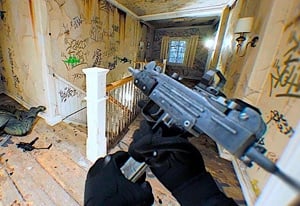
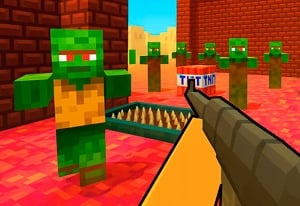
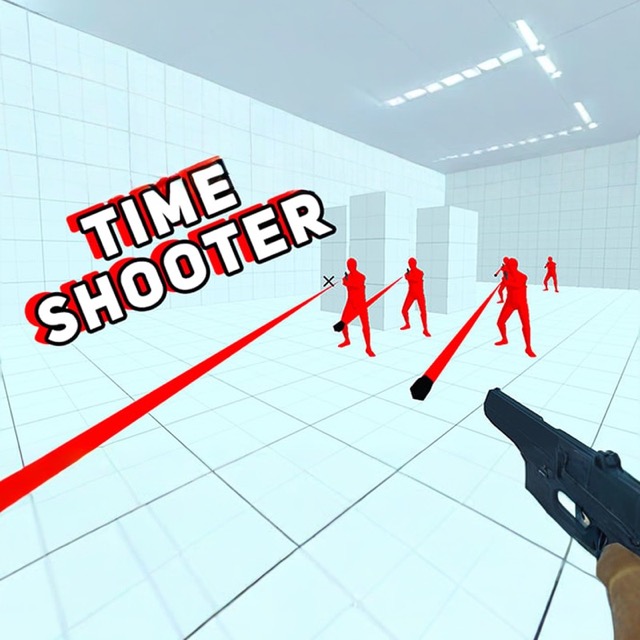
Time Shooter
1. Game Overview
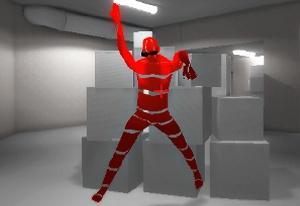
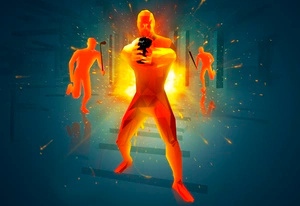
Time Shooter is a first-person shooter built around one of the most elegant mechanical premises in the genre: time only moves when you do. Step forward and the world springs to life — bullets fly, enemies react, the environment shifts. Stop moving and everything freezes mid-action, giving you an unlimited moment to assess, plan, and decide your next move. The result transforms every combat encounter from a reflex test into a tactical puzzle where patience and positioning matter far more than speed.
The mechanic, inspired by the SuperHot series, sounds simple but produces an enormous range of strategic depth. A bullet suspended in the air tells you exactly where to step to avoid it. A frozen enemy mid-swing gives you time to grab a weapon and position yourself for the cleanest possible counterattack. A room full of armed opponents becomes a sequence of deliberate moves rather than a frantic scramble, because you can stop and think at any point in the middle of the chaos.
What makes Time Shooter worth playing on its own terms — beyond the novelty of the mechanic — is how well the level design exploits it. Rooms are small and packed with possibility. Environmental objects can be used as improvised weapons. Door-breaking creates new tactical options mid-encounter. Every situation is a spatial problem with multiple solutions, and the time-stop mechanic gives you the unhurried space to find the right one.
The series includes standout follow-ups in Time Shooter 2 and Time Shooter 3: SWAT, each building on the core premise with new enemies, weapons, and mission objectives. But the original Time Shooter establishes the foundation that makes the whole series work, and it remains the best introduction to what the format is capable of.
Key Details:
| Genre: | First-Person Shooter / Tactical Action |
| Difficulty Level: | Medium |
| Average Play Time: | 10–20 minutes per session |
| Best For: | Tactical shooter fans, puzzle-oriented players, anyone who enjoyed SuperHot |
2. How to Play
Getting Started:
- Launch Time Shooter in your browser — no download or account required.
- Before making your first move in each room, pause and survey the environment from your starting position.
- Move deliberately — each step advances time, so every movement should have a clear purpose.
- Pick up weapons from the environment rather than relying on what you start with; better tools are always nearby.
- Take out the most dangerous enemies first — particularly ranged opponents who can hit you from across the room while you deal with others.
Basic Controls:
| Action | Key |
|---|---|
| Move | WASD |
| Aim | Mouse |
| Shoot | Left Mouse Button |
| Control Time / Secondary | Right Mouse Button |
| Jump | Space |
Objective: Clear each room of enemies by eliminating all threats before they can eliminate you. Use the time-control mechanic — time freezes when you stop moving — to plan your approach, dodge incoming fire, and sequence your attacks. Environmental objects serve as improvised weapons when firearms aren't immediately available. Progress through each level by eliminating enemies and advancing to the next room.
3. Game Features & Highlights
✓ Movement-Controlled Time Mechanic — Time advances only when you move, turning every combat scenario into a tactical puzzle with unlimited decision time and transforming the FPS format into something genuinely unique.
✓ Environmental Weapon System — Almost anything in the environment can be used as a weapon or tool, rewarding creative improvisation and making each room a puzzle with multiple valid solutions.
✓ Deliberate, Chess-Like Combat — No reflexes required — success comes from reading the situation, planning your sequence, and executing with precision rather than reacting faster than your opponents.
✓ Level Variety with Escalating Challenge — Each room presents a new spatial arrangement of enemies and obstacles, ensuring that the solution approach is always context-dependent rather than a repeating formula.
✓ Series Foundation — Time Shooter establishes the core mechanic that Time Shooter 2 and Time Shooter 3: SWAT build upon, making it the ideal starting point for players new to the series.
4. Tips & Strategies
Beginner Tips:
- Always survey before your first move. When you enter a new room, your starting position gives you a frozen snapshot of the entire environment. Identify every enemy, every weapon pickup, and every piece of cover before taking a single step. This pre-move assessment is the most valuable action in any room.
- Move in short, deliberate steps. Long continuous movement advances time significantly and gives enemies more opportunity to react. Short steps with pauses let you reassess after each meaningful time advancement rather than committing to a full movement arc you can't course-correct.
- Prioritize ranged enemies. Enemies with guns are your most immediate danger because they can hit you from across the room while you're engaging other threats. Clear them first, then deal with melee opponents who require you to close distance.
Advanced Strategies:
- Use thrown objects to open engagements. Many environmental objects can be thrown at enemies to deal damage or stagger them before you've picked up a firearm. Starting an engagement with a thrown object buys time — because time moves when the object does — and deals early damage without requiring close approach.
- Position yourself to handle multiple enemies in sequence. Before committing to a movement path, plan where you'll be after each engagement. Approaching enemies from angles that let you eliminate them sequentially rather than simultaneously reduces the number of active threats you're managing at any moment.
- Use frozen bullets as positioning information. When you stop moving and bullets hang in the air, they tell you exactly where to step to avoid them. This information is free — every time you stop, frozen projectiles are an immediate map of where not to be.
What to Watch Out For:
- Moving too fast in complex rooms. Continuous movement through a room with multiple enemies gives each of them time to react and fire simultaneously. Short, controlled advances that keep the situation manageable are consistently more survivable than rushing through a room and hoping to outrun the consequences.
- Ignoring environmental weapons. Players who wait for conventional firearms miss the full range of options the game provides. Chairs, bottles, and other objects are legitimate tactical resources that can handle enemies or create distractions — using them is not a compromise, it's good play.
5. Game Elements Explained
Time-Control Mechanic
The movement-as-time-control mechanic is Time Shooter's defining feature and the source of everything that distinguishes it from conventional first-person shooters. When you move, time moves at roughly normal speed. When you stop, time stops — bullets hang in the air, enemies freeze mid-action, the environment pauses entirely. Resuming movement resumes time. This single rule creates a fundamentally different cognitive relationship with combat than any other FPS format.
The practical effect is that information is never rationed. You can always stop to assess a situation, identify incoming threats, locate weapon pickups, and plan your next sequence of movements before committing to any action. There is no time pressure within the decision window, only within the execution window — once you start moving, time moves with you, and your planned sequence either works or doesn't based on how accurately you read the situation.
This design makes Time Shooter a game where the limiting factor is always clarity of thinking rather than speed of reaction. Players who struggle in conventional shooters because of the reflexive demands often find Time Shooter uniquely comfortable — and players who excel in conventional shooters discover that the strategic ceiling in Time Shooter requires a completely different cognitive approach than raw reflex training provides.
Environmental Weapons & Improvisation
The environmental weapon system reflects a design philosophy where combat creativity is always rewarded over a single correct approach. Firearms appear throughout levels, but so do a range of throwable and improvised options — chairs, bottles, tools, and other objects that can be grabbed and used against enemies. These objects deal damage, create stagger that interrupts enemy attacks, and can be thrown across rooms to initiate engagements from a safe distance before closing in with a firearm.
The system rewards players who treat the entire environment as their toolset rather than scanning exclusively for conventional weapons. A room with no immediately visible firearm is not a disadvantage — it's a puzzle asking which improvised options are available and how they can be sequenced effectively. Learning to read rooms for their full tactical potential, including non-obvious weapon options, is one of the clearest skill developments the game supports.
Improvised weapons also have a time-manipulation advantage: thrown objects move through time with you, meaning that throwing something at an enemy advances time enough for it to reach them without requiring you to physically close the distance. This creates safe engagement options that conventional FPS games don't offer.
Level Design & Room Structure
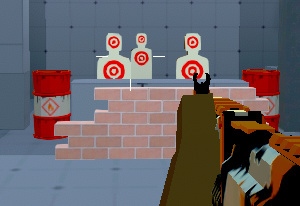
Time Shooter's levels are structured as a sequence of rooms, each presenting a distinct spatial puzzle with a unique arrangement of enemies, obstacles, and weapons. This room-by-room structure serves the time-control mechanic perfectly — each new room is a fresh frozen tableau that you enter with unlimited time to assess before making your first move.
Room design is intentionally compact. Wide, open arenas would reduce the tactical complexity because enemies would have more space between them, creating sequential isolated encounters rather than the multi-threat spatial puzzles that make the mechanic interesting. Tight, multi-obstacle rooms force more creative sequencing and make environmental weapons more relevant, since cover and improvised options are always nearby.
Door-breaking mechanics in some rooms add a layer of tactical timing — choosing when to open or break through a door advances time and exposes you to whatever is on the other side. Pre-positioning before opening a door, and knowing which weapon you'll need for whatever enemy configuration likely waits behind it, is a micro-skill that experienced players develop naturally with level familiarity.
6. Frequently Asked Questions
Q: How does the time-control mechanic work exactly? A: Time in Time Shooter advances at roughly normal speed when you are moving, and stops completely when you stop moving. This applies to everything in the game — bullets, enemies, environmental objects. When you stop, you have unlimited time to assess the situation, adjust your aim, and plan your next movement before resuming. The mechanic is always active; there is no resource to manage or ability to trigger.
Q: What should I do when I enter a room with multiple armed enemies? A: Stop immediately after entering and survey the full room before moving. Identify all enemies, all weapon pickups, and all cover options. Plan your first sequence: move to the nearest weapon pickup, take the most dangerous ranged enemy first, then work through remaining threats in order of danger. Execute that sequence in deliberate short steps, stopping to reassess between each meaningful action.
Q: Is Time Shooter related to SuperHot? A: Time Shooter is inspired by SuperHot's time-control mechanic — movement-controlled time is the shared premise of both games. Time Shooter is a separate, independently developed title, not an official SuperHot product. It offers a comparable experience in a browser-accessible format.
Q: Is Time Shooter playable on mobile and tablet? A: Yes. Time Shooter is a browser-based HTML5 game accessible on desktop, mobile, and tablet platforms without any download required. Desktop with a mouse and keyboard provides the optimal control experience, but mobile play is supported.
Q: How does Time Shooter differ from Time Shooter 2 and Time Shooter 3: SWAT? A: All three games share the core movement-as-time-control mechanic. Time Shooter 2 expands the weapon variety and enemy configurations while refining the core formula. Time Shooter 3: SWAT adds mission objectives — specifically hostage rescue — and introduces enemies with SWAT gear including riot shields and body armor that require more deliberate tactical approaches. Time Shooter is the best starting point for players new to the series.
7. Related Games You Might Enjoy
If you like Time Shooter, you might also enjoy:
- Time Shooter 3 - It keeps the same time-control shooter DNA while changing the mission structure and enemy pressure.
- Time Shooter 2 - It keeps the same time-control shooter DNA while changing the mission structure and enemy pressure.
- Time Shooter Hot: Slowdown Confrontation - It keeps the same time-control shooter DNA while changing the mission structure and enemy pressure.