





Undead Corridor
1. Game Overview
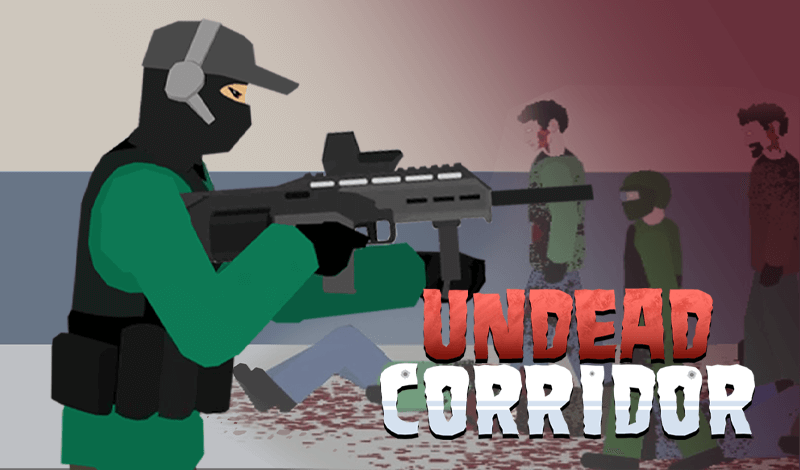
Undead Corridor is a survival shooter built on a single brutal premise: clear as many zombie-infested corridors as you can before the undead overwhelm you. Each corridor you survive becomes the next corridor's opening threat — enemies move faster, appear in greater numbers, and leave you fewer opportunities to recover. There is no safe plateau. The game doesn't let you settle into a comfortable rhythm. Every decision about ammunition, positioning, and weapon selection matters because the margin for error shrinks with every door you push through.
The game's roguelite structure gives each run genuine stakes. You start with two weapons — typically an assault rifle and a sidearm — and earn money by killing zombies. That money can buy better ammunition or upgrade your firepower between runs, but if you die, your weapons are lost. The upgraded loadout you spent three runs building is gone. Only your currency and statistical progress carry forward, creating the classic roguelite tension between survival and investment.
What separates Undead Corridor from other zombie shooters is how much atmosphere it wrings from minimalist 2D art. Ragdoll physics make every headshot feel weighty — enemies respond differently depending on where they're hit. Sound design does heavy lifting: groans from unseen zombies, footsteps that suggest something approaching before it appears, and the ambient tension of a corridor that might be empty or might not. Players consistently describe it as more nerve-wracking than the visual style initially suggests it should be.
Multiple environments — Hospital, Office, Corridors, Rooms, Defense, and City Park — each bring different spatial layouts and zombie concentrations, ensuring that the game's escalating challenge manifests differently across each setting.
Key Details:
| Genre: | Survival Shooter / Roguelite |
| Difficulty Level: | Medium to Hard (escalates continuously) |
| Average Play Time: | 10–25 minutes per run |
| Best For: | Survival game fans, zombie shooter enthusiasts, players who enjoy roguelite progression loops |
2. How to Play
Getting Started:
- Launch Undead Corridor in your browser — no download or account required.
- Select your starting environment and review your weapon loadout before the run begins.
- Choose your ammunition type based on the zombie types you expect — armor-piercing for tough enemies, soft point for crowd control.
- Enter the first corridor and immediately identify chokepoints — doors and narrow hallways funnel zombies for more efficient kills.
- Earn money from kills, survive as many corridors as possible, and invest upgrade earnings wisely before your next run.
Basic Controls:
| Action | Key / Input |
|---|---|
| Move | A / D or Arrow Keys |
| Shoot | Left Mouse Button / Tap |
| Reload / Change Weapon | R or On-Screen Icon |
| Switch Weapon | Mouse Scroll / Weapon Icon |
| Aim | Automatic or On-Screen Direction |
| Pause | ESC |
Objective: Clear as many corridors as possible without dying. Kill zombies to earn money, use that money to purchase better ammunition and weapon upgrades, and survive increasingly difficult waves as zombie speed, aggression, and numbers multiply corridor by corridor. When you die, weapons are lost — but currency carries over to fund upgrades for your next run.
3. Game Features & Highlights
✓ Dynamic Difficulty Scaling — Zombies multiply at 1.5x per corridor and grow progressively faster and more aggressive, ensuring the challenge never plateaus and always demands tactical adaptation.
✓ Ammunition Type System — Three distinct ammo types (balanced, armor-piercing, and soft point) offer meaningful pre-run tactical choices that affect crowd control, single-target damage, and ammo efficiency differently.
✓ Roguelite Weapon Loss Mechanic — Weapons drop permanently on death, creating genuine stakes for every run and making survival decisions feel consequential rather than abstract.
✓ Multiple Environments — Hospital, Office, Corridors, Rooms, Defense, and City Park each present different spatial layouts and zombie densities, with distinct tactical challenges across each setting.
✓ Ragdoll Physics & Sound Design — Hit-location-dependent ragdoll responses and atmospheric audio — groans, footsteps, ambient dread — create a tense survival atmosphere that exceeds what the minimalist 2D art style suggests on first glance.
4. Tips & Strategies
Beginner Tips:
- Aim for headshots consistently. Headshots are significantly more ammo-efficient than body shots — they eliminate zombies faster while consuming fewer bullets. In a game where every round matters, developing headshot discipline in early corridors pays compounding dividends in later, harder ones.
- Use corridor geometry as a tactical tool. Narrow hallways and doorways force zombies into single-file approaches where you can eliminate them one at a time rather than handling spread-out groups simultaneously. Positioning yourself at the far end of a narrow corridor with a clear sightline to a door is almost always safer than fighting in open rooms.
- Conserve your stronger ammunition for dense waves. Switching to armor-piercing rounds at the start of a wave risks burning through limited supplies before you need them most. Use standard ammunition until the wave composition demands something more specialized.
Advanced Strategies:
- Invest in ammunition upgrades before weapon unlocks. Better ammunition types improve every weapon you carry, while new weapon unlocks only benefit that specific gun. Ammo upgrades have a broader return across the entire run and are consistently the higher-value early investment.
- Stay mobile throughout each corridor. Zombies move faster in later corridors than most players initially expect. Remaining stationary — even in an apparently safe position — becomes untenable after the first several corridors, when zombie speed reaches levels that can close distance too quickly to react if you're not already repositioning.
- Use the soft point ammunition for crowd control on mixed waves. The bleeding effect applied by soft point rounds continues dealing damage after the initial hit, effectively giving you passive damage output on multiple targets simultaneously. In high-density corridors where direct engagement with every zombie isn't possible, this type significantly reduces the effective threat count.
What to Watch Out For:
- The 1.5x zombie multiplier across corridors. The mathematical escalation of zombie numbers is steeper than it intuitively feels in the first few corridors. Players who play conservatively early and think the difficulty is manageable often encounter an abrupt ceiling around corridor five or six where the multiplier has compounded significantly. Start treating ammo and health conservatively from corridor one, not when it starts feeling dangerous.
- Losing weapons on death without upgrading between runs. The post-death currency carries over, but failing to spend it on meaningful upgrades before your next run means you're starting the same difficulty with the same baseline tools. Always spend available upgrade currency before beginning a new run.
5. Game Elements Explained
Roguelite Structure & Weapon Loss
Undead Corridor's roguelite structure is what gives the game its tension and long-term engagement. Each run begins with a standard loadout — assault rifle and sidearm — and the run's longevity determines how many kills you accumulate and therefore how much currency you earn for future upgrades. When a run ends in death, every weapon you were carrying is permanently lost for that session. Only the currency and your overall statistics persist.
This weapon loss mechanic creates a different relationship with gear than conventional shooters provide. In a game where your weapons might disappear permanently at any moment, every ammunition decision carries weight. Burning through armor-piercing rounds on enemies that standard ammunition could handle is a genuine mistake, not just a suboptimal choice. The scarcity introduced by potential weapon loss makes resource management a skill rather than a secondary consideration.
The currency that persists across runs funds ammunition upgrades and weapon enhancements that improve your baseline on future attempts. This creates the roguelite loop: each run builds currency, currency builds capability, and capability extends future runs further into the corridor sequence. Players who engage with the upgrade system deliberately and consistently compound their survival potential in ways that purely skill-based improvement alone can't match.
Ammunition System
The three-tier ammunition system is Undead Corridor's primary tactical decision point before each run begins. 5.56x45D (Default) provides a balanced combination of damage and range that performs reliably across all zombie types and corridor configurations — it's the all-purpose choice when the run's specific challenges are unknown. 5.56x45A (Armor-Piercing) deals enhanced damage against the game's tougher zombie variants, trading ammo economy against dramatically increased per-shot effectiveness on armored or resilient targets. 5.56x45S (Soft Point) applies a bleeding status effect that continues dealing damage after impact, making it the best option for high-density corridors where managing multiple simultaneous threats is the primary challenge.
The ammunition choice is not permanent within a run — switching between types during a corridor allows tactical adjustment to changing threat compositions. However, the pre-run selection determines which type you enter with and in what quantity, making the initial decision consequential even if it can be modified later.
Understanding which ammunition type addresses the specific weakness of the zombies you're currently facing — and switching to match the threat rather than defaulting to the same type throughout — is one of the clearest signs of developing expertise in Undead Corridor's combat system.
Environment Variety & Spatial Design
The six environments in Undead Corridor — Hospital, Office, Corridors, Rooms, Defense, and City Park — are not cosmetic variations of the same experience. Each presents a distinct spatial layout that favors different tactical approaches and creates different primary threats.
Hospital environments favor tight corridor combat with frequent doorway chokepoints, rewarding players who use narrow approaches to funnel zombie movement. Office environments introduce more open floor plans that reduce chokepoint availability but provide more lateral movement space for repositioning. City Park breaks from interior environments entirely, introducing wider sightlines and less structural cover that demand a more mobile, less position-dependent approach.
The variation in zombie concentration across environments adds another layer — some settings spawn denser initial waves that require faster establishment of control, while others allow slightly more time to set defensive positions before the first wave arrives. Switching between environments rather than replaying the same one repeatedly is the fastest way to develop a well-rounded understanding of the game's full tactical range, because skills that feel complete in one environment often have unexplored gaps when a different spatial context is applied.
6. Frequently Asked Questions
Q: What happens to my weapons when I die? A: All weapons in your possession at the time of death are permanently lost for that run. Your earned currency is retained and can be used for upgrades before your next run. This is the game's core roguelite mechanic — weapons are earned through survival, not given as permanent possessions, making every run's gear feel like something worth protecting.
Q: What's the best ammunition type for beginners? A: Start with the default 5.56x45D for your first several runs to understand the baseline combat feel. Once you're comfortable with movement and positioning, experiment with soft point rounds in higher-density corridors — the bleeding effect provides passive damage output that's particularly valuable when zombie counts make direct engagement of every target impractical.
Q: Is Undead Corridor free to play? A: Yes. Undead Corridor is completely free to play in any web browser on desktop and mobile without any download or account required.
Q: Can I switch weapons during a run? A: Yes. You can switch between your primary and secondary weapon at any time using the mouse scroll wheel or the weapon icon on-screen. Switching between weapons mid-corridor is a viable tactical option when one weapon is better suited to the current range or zombie type than the other.
Q: Does difficulty keep increasing indefinitely? A: Yes. Zombie speed, aggression, and numbers multiply by 1.5x with each corridor cleared, and this scaling continues indefinitely with no difficulty cap. There is no final corridor — the game ends when you're eliminated, and the goal is always to push further than your previous best.
7. Related Games You Might Enjoy
If you like Undead Corridor, you might also enjoy:
- Super Moncat - It offers another strong shooter pick with fast browser play and familiar action pacing.
- X Trench Run - It offers another strong shooter pick with fast browser play and familiar action pacing.
- Hunting Online - It offers another strong shooter pick with fast browser play and familiar action pacing.