



That's Not My Neighbor
1. Game Overview
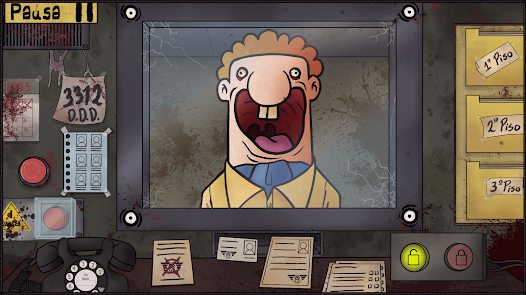
That's Not My Neighbor is a puzzle horror game that places you at the front door of a dystopian apartment complex with one job: decide who gets in and who doesn't. You're the doorman. Residents have IDs, permits, and appointments. Some of the people knocking are exactly who they say they are. Others are doppelgängers — shape-shifting impostors who replicate residents with unsettling accuracy — and letting one through is a failure that carries real consequences.
The game works because the deduction is genuinely difficult. Doppelgängers don't announce themselves. They present documents, behave plausibly, and exploit the gap between what the paperwork says and what you actually know. Catching them requires cross-referencing ID cards against known resident information, listening for inconsistencies in what they say, watching for behavioral details that don't quite fit, and making a judgment call under the slow-building pressure of not knowing whether you got it right until it's too late.
What gives That's Not My Neighbor its distinctive tone is the slow-burn horror design. There are no constant jump scares as a cheap substitute for tension — the dread is ambient, built from the accumulating anxiety of a job where a single mistake has serious consequences and where the criteria for distinguishing real residents from impostors is never as clear as you'd like it to be. The art style and sound design reinforce a pervasive sense of wrongness that makes even correct decisions feel uncertain.
It's a game that rewards careful attention, methodical thinking, and the willingness to make high-stakes calls on incomplete information. If that combination of logic puzzle, psychological pressure, and horror atmosphere sounds appealing, That's Not My Neighbor is one of the best browser-based examples of the genre.
Key Details:
| Genre: | Puzzle Horror / Deduction |
| Difficulty Level: | Medium to Hard |
| Average Play Time: | 20–40 minutes per session |
| Best For: | Puzzle game fans, horror enthusiasts, players who enjoy deduction and decision-making under pressure |
2. How to Play
Getting Started:
- Launch the game in your browser — no download or account required.
- Review the resident registry and any documents available to you before your shift begins — these are your reference materials for every subsequent decision.
- When someone knocks, examine their ID card and any permits they present carefully.
- Cross-reference what they present against the resident registry and behavioral cues before making your admission decision.
- Allow entry if you're confident they're a legitimate resident; deny entry or escalate if something doesn't add up.
Basic Controls:
| Action | Input |
|---|---|
| Interact with People & Objects | Left Mouse Click |
| Inspect Documents & Visual Cues | Hover / Mouse |
| Shooting (when threat emerges) | Right-Click (version dependent) |
Objective: Correctly identify legitimate residents and deny entry to doppelgänger impostors across your shift. Success requires careful document analysis, behavioral observation, and confident decision-making under pressure. Allowing a doppelgänger through or denying a legitimate resident both carry consequences — the goal is accuracy, not simply caution in one direction or the other.
3. Game Features & Highlights
✓ Logic-Based Deduction Gameplay — Every admission decision is a deduction puzzle requiring cross-referenced document analysis, behavioral observation, and judgment under uncertainty — genuine cognitive challenge rather than pattern recognition alone.
✓ Slow-Burn Horror Atmosphere — Ambient dread built from accumulating tension and deliberate sound design rather than cheap jump scares, creating sustained psychological discomfort that defines the game's emotional tone.
✓ Unpredictable Outcomes — Random elements ensure that each playthrough presents different doppelgänger configurations and scenarios, making repeated sessions genuinely distinct rather than pattern-repeating exercises.
✓ Document Analysis System — ID cards, permits, and behavioral clues form a multi-layered information system that requires active cross-referencing rather than surface-level checks to use effectively.
✓ Shooting Sequences — When deduction gives way to immediate threat, the game shifts into direct action, requiring players to shift mental modes rapidly from investigative to reactive.
4. Tips & Strategies
Beginner Tips:
- Read the resident registry thoroughly before your shift. The information in the registry is your primary reference tool. Residents you've memorized are much easier to verify quickly; those you haven't reviewed leave gaps that doppelgängers exploit. Treat the pre-shift review as a required step, not an optional one.
- Check more than one document element. Doppelgängers who present convincing IDs may have inconsistencies in their permits, appointment records, or behavioral details. No single document element is sufficient for confident admission — cross-reference at least two independent sources before deciding.
- Notice behavioral details, not just documents. How someone presents themselves — their hesitation, their language choices, their reaction to specific questions — can contradict an otherwise legitimate-looking set of documents. Trust your observation of behavior alongside the paper evidence.
Advanced Strategies:
- Develop a consistent verification checklist. The best approach to the game's deduction challenge is a personal checklist of elements you verify in a fixed order for every visitor: photo match, name match, apartment number, permit validity, behavioral consistency. Running through the same checklist every time prevents the cognitive fatigue that causes missed details on longer shifts.
- Let tension be informative. The game's horror atmosphere is not separate from its gameplay — it's a signal. If a visitor makes you inexplicably uneasy even when the documents appear to check out, that discomfort may reflect a subtle inconsistency you haven't consciously identified yet. Go back over the documents rather than overriding the feeling immediately.
- Treat denial as a legitimate option, not a last resort. New players often err toward admission because denial feels confrontational. In That's Not My Neighbor, denial when uncertain is frequently the correct call — a denied legitimate resident is inconvenienced; an admitted doppelgänger has far worse consequences. When genuinely uncertain, deny and note what prompted the uncertainty.
What to Watch Out For:
- Familiarity bias. A visitor who presents confidently and consistently with how you'd expect a resident to behave is not automatically legitimate — doppelgängers are specifically designed to exploit the assumption that confident behavior equals honest behavior. Confidence in presentation is not a substitute for document verification.
- Rushing during high-traffic periods. When multiple visitors arrive in sequence, the pressure to process them quickly can lead to shortcuts in your verification checklist. This is precisely when doppelgängers are most likely to slip through. Maintain your full checklist even when the pace increases.
5. Game Elements Explained
Doppelgänger Detection System
The doppelgänger detection system is the core mechanical and narrative engine of That's Not My Neighbor. Impostors present themselves at the door with documents that range from convincingly accurate to subtly wrong, and your job is to identify which category each visitor falls into before making an admission decision. The challenge is calibrated so that the easiest doppelgängers have detectable inconsistencies across multiple document types, while harder impostors may have only one subtle behavioral or visual tell that distinguishes them from the resident they're imitating.
The information sources available to you — ID cards, permits, appointment records, resident registry entries, and behavioral observation — are designed to be used in combination. No single source is reliably sufficient on its own. A photo that matches may accompany a name that doesn't quite align with the registry. A name that matches may be paired with an apartment number that belongs to a different resident. The game trains you to cross-reference systematically rather than rely on any single check.
The random element in how doppelgängers are configured each playthrough means that memorized solutions from previous runs don't carry over cleanly. Each session presents a fresh arrangement of impostors and inconsistencies, ensuring that genuine deductive reasoning remains required rather than becoming pattern recognition from prior experience.
Document Analysis Mechanics
The document system in That's Not My Neighbor functions as a multi-layered evidentiary framework. Each visitor presents a set of documents — typically including at minimum an ID card — which you can examine by hovering over individual elements to inspect them more closely. The resident registry maintained at your station serves as the ground truth against which everything presented must be verified.
ID cards contain several independently verifiable elements: the resident's photo, their name, their apartment number, and potentially other identifying details. Each of these can be checked against the registry, and doppelgängers may falsify some elements while leaving others accurate — requiring element-by-element verification rather than a single overall assessment.
Permits and appointment records add additional verification layers for visitors who claim to be arriving for specific purposes. A visitor claiming an appointment that doesn't appear in the appointment log, or presenting a permit that doesn't match the registered version, is a significant red flag. Learning to integrate all available document types into a unified assessment — rather than stopping verification after the ID appears to check out — is the primary skill development challenge the document system presents.
Atmosphere & Horror Design
That's Not My Neighbor's horror design is built around sustained psychological discomfort rather than shock-based scares. The art style creates a visual environment that feels slightly wrong in ways that are difficult to articulate precisely — character designs that are almost normal, environments that have an unsettling undertone, visual details that don't resolve comfortably even under direct inspection. This persistent low-level wrongness is the game's most effective horror tool.
Sound design reinforces the atmosphere systematically. Ambient audio creates a constant background unease. Voice performances for visitors carry subtle inconsistencies that register as uncomfortable before the player can identify exactly what's wrong. The cumulative effect is an experience where even routine admission decisions carry weight, because the environment has established that nothing is fully safe and no decision is fully certain.
The horror atmosphere is not decorative — it's mechanically integrated with the deduction gameplay. The psychological discomfort that builds across a shift affects decision-making in ways that mirror real cognitive fatigue, making the game harder the longer you play without resolution. Managing that mounting tension without letting it compromise your methodical verification process is as much a part of succeeding at That's Not My Neighbor as any specific deduction skill.
6. Frequently Asked Questions
Q: How do I tell if someone is a doppelgänger? A: Cross-reference every document element they present against the resident registry — photo, name, apartment number, and any additional details — rather than making an overall gestalt judgment. Also attend to behavioral cues: hesitation, inconsistent language, or reactions to specific questions that don't fit someone who genuinely lives in the building. Doppelgängers typically have at least one detectable inconsistency across these combined sources.
Q: What happens if I deny a legitimate resident by mistake? A: Incorrectly denying legitimate residents has consequences that differ from admitting doppelgängers, but both types of errors affect your performance across the shift. The game tracks your accuracy, and consistent errors in either direction — over-admission or over-denial — reflect in your outcomes. The goal is accurate discrimination, not blanket caution.
Q: Is That's Not My Neighbor playable on mobile and tablet? A: Yes. The game is a browser-based HTML5 title supported on desktop, mobile, and tablet platforms without any download required. The point-and-click control scheme translates to touch input on mobile devices.
Q: How much does randomization affect each playthrough? A: Each playthrough presents a different configuration of doppelgängers and legitimate residents, meaning the specific inconsistencies you'll need to identify vary between sessions. The deduction skills and verification habits you develop carry over fully, but memorized solutions from one run won't apply directly to another. The randomization is what makes repeated playthroughs feel distinct rather than repetitive.
Q: Is the game appropriate for players sensitive to horror content? A: That's Not My Neighbor contains horror atmosphere, jump scares, and thematic content involving impostors and implied violence. It does not rely heavily on graphic gore, but the psychological horror elements are central to the experience rather than incidental. Players who are sensitive to sustained tension or horror themes should approach the game with that in mind.
7. Related Games You Might Enjoy
If you like That's Not My Neighbor, you might also enjoy:
- GTA: San Andreas - It offers another strong 3d pick with fast browser play and familiar action pacing.
- GTA: Vice City - It offers another strong 3d pick with fast browser play and familiar action pacing.
- OpenFront.io - It offers another strong 3d pick with fast browser play and familiar action pacing.